JUST BEFORE THE PARTYING START….THINK ABOUT THESE ISSUES! (Part Two)

Documentation Sufficiency State consolidated emblems, state gaseous emission pass, state driver’s badge, Niger Delta Development Permit, National Union Stickers, Inter-Auto Trade Supply Permit, Vehicle operational Permit…e.t.c. and other mandatory emblems without which your journey beyond the western states could be a living hell in the hand of touts and local government officials. The set you obtained for both the full […]

Continue reading »

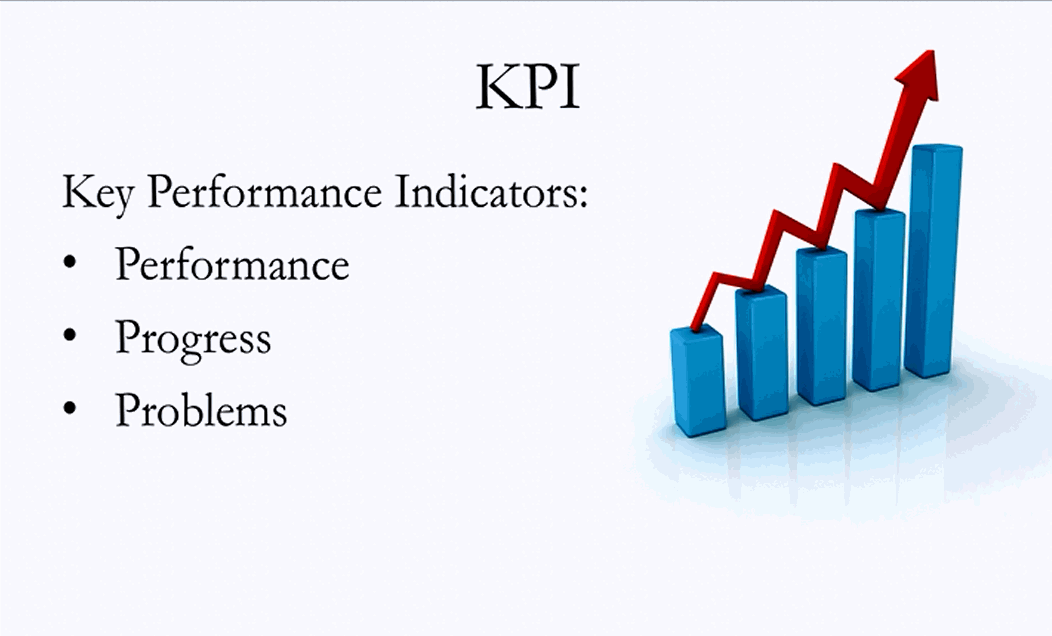
THE IMPORTANCE OF KEY PERFORMANCE INDICATORS (KPIs) IN HAULAGE BUSINESS (Part Two)

Measuring Overall Performance A Director or Senior Manager within a company is likely to be most interested in overall performance and bottom-line financial results. For a haulage company incorporating warehouse operations, these could be measured by the following KPIs: Overall cost of deliveries, such as cost per case/pallet Total transport cost per trip Total transport cost per drop  Total transport […]

Continue reading »

THE IMPORTANCE OF KEY PERFORMANCE INDICATORS (KPIs) IN HAULAGE BUSINESS (Part One)

Logistics management is that link in the supply chain that plans, implements and controls the efficient and effective forward and reverse flow and storage of goods between point of origin and point of consumption. Every properly established integrated haulage services company is in the business of logistics management and the role they play is an integrating function involving the coordination […]

Continue reading »

Bringing the Boss up to speed in Fleet Management: A Teacher’s Approach (Part Two)

Teach Fleet Management 101 Unless the new boss has some background or understanding of fleet management, the next step is to begin the education process. The fleet manager has “felt out” the new manager, based on several factors, including where he or she came from, early discussions or communications, and specific questions that may have been posed. Fleet managers should […]

Continue reading »

Bringing the Boss up to speed in Fleet Management: A Teacher’s Approach (Part One)

Picture this: You are Fleet Manager saddled over the years with the responsibility of profitably managing a fleet comprising over a hundred heavy duty vehicles that moves a minimum of 10,000 tons of goods for counterparties all across the federation in any single month. Suddenly, you get an internal memorandum that tells of the impending resumption of a General Manager […]

Continue reading »

A Critical Assessment of Replacement Policy and its Relevance in Haulage Business (Part Two)

Old trucks for New

METHODS OF ESTIMATING A MOST OPTIMAL REPLACEMENT CYCLE SIMPLISTIC REPLACEMENT PLAN The simplest replacement pro­gram and the one requiring the least amount of analysis is to replace a vehicle after a specific amount of time. It is not rocket science to count up how long the truck has been in service and determine ahead of time what time you simply […]

Continue reading »

Enhancing the Performance of your Haulage Business (Part Two)

FUEL MANAGEMENT SYSTEM With fuelling accounting for 30% (if not more) of the operational cost of most haulage businesses, it will make a lot of sense to state that a policy geared towards reducing fuel consumption or getting better mileage for same volume of fuelling will most assuredly impact positively on haulage operational efficiency and performance. Within the haulage industry […]

Continue reading »

Enhancing the Performance of your Haulage Business (Part One)

Generally speaking, Performance in any business is measured in terms of the relationship that exists between the resources deployed towards the sustenance of that business or enterprise and the end-result as measured by the output or value of product/service thereby generated. Haulage business in Nigeria in the last 5years has witnessed tremendous growth in terms of the quantum of fresh […]

Continue reading »

A Critical Assessment of Replacement Policy and its Relevance in Haulage Business (Part One)

Old trucks for New

In haulage business, Replacement Policy is one of the most critical aspects of fleet management which should be of considerable interest to business owners. Nearly every other cost, both fixed and variable, hinges upon when vehicles are replaced. Maintenance and repair expense, fuel efficiency, and of course, depreciation are all sensitive to replacement policy.   REPLACEMENT POLICY DEFINED: ITS RELEVANCE […]

Continue reading »
1 5 6 7 8